|
|
 |
'macthunder' |  |
 Proclamation |
MacT Proclamation |
MacT |
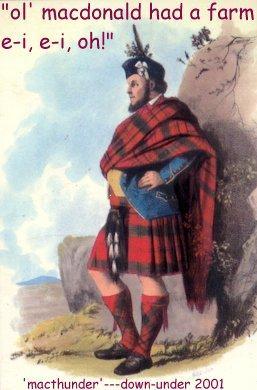
| A statement to the Global nation of Scots.....! Caoimhín Murchadh Macdonald MacToirdealbhaigh 'macthunder' "as with ancient times the pipers and the drummers have led the people to battle. The war that I wage is not against any living thing .The battle that I'm engaged in is to do with ancient Scottish rights and the international communities perception of same in the global market place. In this respect I'm bangin' on a big bass drum!" PROCLAMATION To all the brothers & sisters in our global nation of Scots: "I Caoimhín Murchadh Macdonald MacToirdealbhaigh have a vision and a scenario that if accepted and effected will catapult the global nation of Scots onto the world stage in the most positive light or I am not the first born grandson of William Wallace Macdonald."(1899-1984) |
 |
|
| My Scot/Irish Ancestors Throughout the 17th and 18th centuries, the English invasion of Ireland displaced most of the remaining Gaelic tribes, with most of the tribes either wiped out by warfare or starvation, sold into slavery in the West Indies and Americas, or forced into the Donegal and Galway regions of Western Ireland. Gaelic language, religion, traditions, dress, art, music and any other cultural or religious items were outlawed by the English on pain of death. Likewise, the English forced the surviving Gael from their lands, seizing them and giving them to English landlords. Stripped from their lands, which are integral to their culture, the Gael began to lose touch with their traditions and their roots. |
In the 19th and early 20th PLEASE READ ON................ In closing, it is important to note some key conclusions made by a review of Gaelic native beliefs. First among these is the fact that, Though the Gael may look like any other American, Canadian or Australian of European origins, they have a vastly different and utterly alien world-view and thought process. This is due to the second conclusion- That the Gael have an unbroken cultural heritage tracing back directly to antiquity, and remember things as a people long forgotten by others. This is because, as a third conclusion, They are, in the opinion of many observers, closer to the primal root nature of man than many other cultures. This observation is made more from direct observation of their social structure and interaction than any documented science. It has been said that the Gael share similarities in social structure with a wolf-pack more than the formal nation-structures of ‘civilized’ man. Yet, this seemingly feral nature is tempered by their incredible talent as artists, poets, philosophers, musicians and tacticians. They are, as a final observation, a contradiction given form; warrior-poets following a pack-like tribal society that is held together by an intricate social and legal structure. |
|
Thus began the Diaspora. The Diaspora created a schism.....! |
"...our hope is constant in thee..!" |
|